
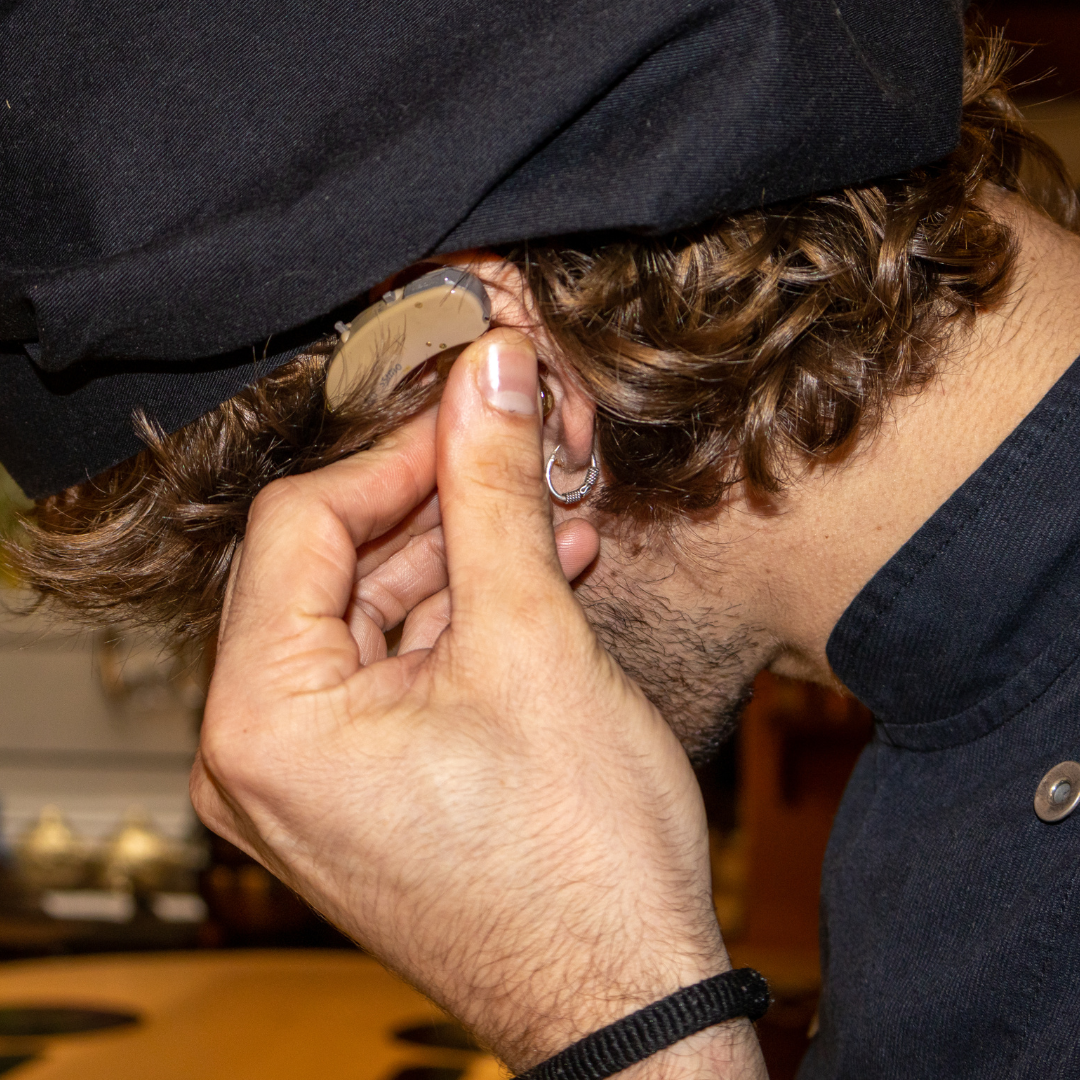
Tracking speech in busy dining venues can feel exhausting when environmental noise drowns out your hearing. Our practice can evaluate hearing in both quiet and noisy conditions to identify what makes these environments difficult. Once the diagnostic etiology of your difficult hearing is established, we implement personalized clinical and technological strategies.
Explaining Normal Quiet Hearing Versus Restaurant Listening Fatigue
A quiet setting creates an optimal signal-to-noise ratio, ensuring the conversational partner’s voice rises cleanly above ambient sounds. Commercial restaurant spaces present the polar opposite acoustic dynamic. Competing conversations, background music, tableware clatter, and acoustic reflections clash with incoming speech, making auditory processing exceptionally strenuous.
Such difficulty frequently signals sensorineural high-frequency hearing loss, auditory processing dysfunction, or noise-induced cochlear damage. Dim lighting, physical tiredness, conversational distance, and divided attention exacerbate these listening deficits. Certain patients demonstrate normal sensitivity on routine audiograms while struggling significantly during advanced speech-in-noise testing. Disproportionate difficulty in restaurants justifies professional clinical assessment even if your everyday home hearing appears intact.
How Is High-Frequency Hearing Loss Diagnosed?
Diagnostic assessment begins by documenting specific listening breakdowns, recreational noise exposure, tinnitus symptoms, medications, and hereditary auditory patterns.
Through pure-tone audiometry, we determine your faintest auditory perception across low to high pitches utilizing both air and bone conduction testing. In high-frequency hearing loss, the audiogram reveals a sloping configuration where hearing acuity drops progressively as pitch frequencies increase. Comprehensive evaluations frequently include impedance tympanometry to examine middle-ear function and recorded word-recognition testing to measure speech understanding.
Standard quiet test booths fail to simulate real-world restaurant noise, making speech-in-noise testing a crucial clinical tool. This procedure gauges speech-discrimination accuracy while competing multi-source noise becomes incrementally louder. In combination, these diagnostic metrics reveal whether communication hurdles involve audibility thresholds, speech discrimination, neural noise management, or mixed conditions.
How Auditory Processing Difficulties Impact Adult Hearing
A central auditory processing disorder disrupts the neurological transmission and cognitive interpretation of sound waves. A patient’s ears may demonstrate normal pure-tone sensitivity, but their central processing system struggles to separate background babble, distinguish consonant sounds, or follow swift discussions. Our protocol begins by thoroughly testing peripheral hearing before determining if a specialized central auditory-processing battery or interdisciplinary referral is warranted.
How to Improve Speech Clarity in Challenging Acoustic Environments
Small changes can improve the signal reaching your ears and provide clearer visual cues. Prior to dining, choose venues known for lower noise levels or schedule meals during quieter dining hours. Dining locations utilizing sound-absorbing elements like booths, felt panels, window curtains, and carpet offer better acoustics than high-ceilinged rooms with hard surfaces.
While seated at the restaurant:
- Ask host staff for a quiet table distanced from kitchen traffic, bar noise, audio speakers, and loud group tables.
- Choose a seat with your back against a solid wall to block acoustic clutter originating from behind.
- Position yourself directly opposite your companions where direct lighting highlights their facial expressions.
- Sit as close to the speaker as comfort permits to preserve speech volume and clarity.
- Place your better-hearing ear toward the person you most want to hear.
- Request that companions rephrase misunderstandings using different words rather than repeating the same sentence.
- Clarify critical details explicitly instead of nodding along or pretending to catch the message.
- Excuse yourself for a momentary quiet pause when listening exhaustion starts to mount.
- Ask dinner guests to speak with clear enunciation at a steady, natural conversational rate.
- Shouting creates acoustic distortion that actively compromises speech understanding rather than helping.
The Best Hearing Devices for Overcoming Restaurant Noise
Optimal technological solutions depend entirely on the etiology of your symptoms, target acoustic spaces, and whether measurable hearing loss exists. Advanced hearing aids utilize beamforming directional microphones, adaptive noise reduction, and specialized restaurant programs to elevate voices directly ahead while suppressing ambient chatter. Realistic expectations are vital, since even advanced hearing devices cannot completely erase background conversational chatter.
Incorporating a dedicated remote microphone provides an even more pronounced improvement in signal-to-noise ratio. Worn on the speaker’s collar or set on the table, the microphone broadcasts direct audio to paired hearing aids or specialized receivers. By streaming directly, this technology overcomes acoustic falloff from distance and surrounding environmental noise.
Alternative assistive hearing tools include:
- Wireless conference table microphones that capture multi-speaker discussions
- Telecoil components connecting directly to public hearing-loop systems
- Smartphone live-captioning platforms providing instant speech-to-text visual support
- Over-the-counter hearables equipped with directional speech-enhancement algorithms
- Acoustic sound-meter apps and dining review directories that score restaurant noise
We analyze suitable devices, verify functional compatibility with your current setup, and guide you through real-world operation.
How Can a Doctor Help with Hearing in Loud Places?
A professional clinical assessment moves beyond basic baseline statements like “I hear fine in quiet rooms.” We examine the challenging acoustic venues, conversational setups, and noise profiles you encounter to select appropriate diagnostic tests. Testing routinely combines pure-tone audiometry, middle-ear impedance tests, speech discrimination, and speech-in-noise measures. Specialized auditory-processing testing can be ordered when patient history and preliminary audiometric findings warrant deeper neural investigation.
Sudden, one-sided, or rapidly worsening symptoms may require medical evaluation by an ear, nose, and throat physician. Dedicated individualized care pinpoints the underlying auditory cause rather than dismissing your struggles as standard restaurant noise.
Book Your Comprehensive Hearing Evaluation Now
If struggling through dinner conversation leaves you mentally exhausted, detached, or constantly guessing, schedule a complete hearing evaluation with our clinic. Our specialists can introduce effective interventions to support your hearing in noisy environments via precision hearing aid fittings, assistive devices, or audiological rehabilitation.
Contact our practice today to book your consultation and take a decisive step toward reconnecting in social settings.